
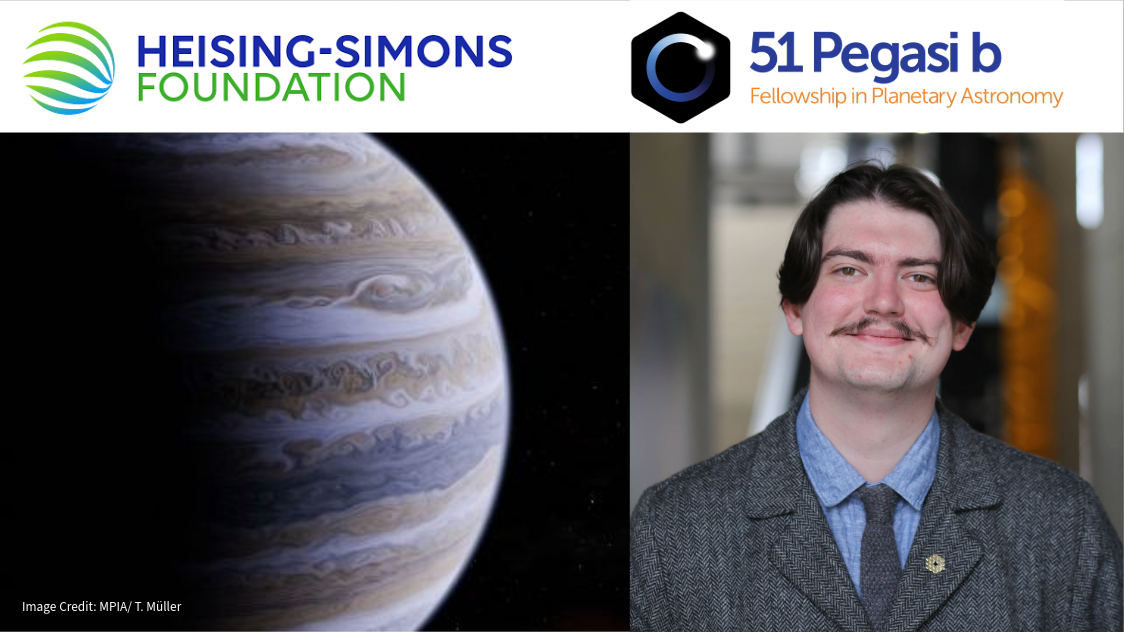
The Center for Interdisciplinary Exploration and Research in Astrophysics (CIERA) is proud to announce that William Balmer (they/them) has been named Northwestern University’s first Heising-Simons Foundation 51 Pegasi b Fellow and a member of the Tenth Class of 51 Pegasi b Fellows.
This prestigious postdoctoral fellowship supports outstanding planetary astronomers with the opportunity to conduct theoretical, observational, and experimental research in planetary astronomy over a three-year period.
“I am incredibly excited to join Northwestern as a 51 Peg b Fellow,” says Balmer. “I hope to apply new techniques to image exoplanets that haven’t been seen before and I have no doubt that CIERA’s supportive community will help me achieve my goals.”
Balmer specializes in coronagraphy using instruments that block starlight to reveal faint planets. The challenge is separating planetary signals from residual starlight, which current algorithms from the early 2000s struggle to remove. Balmer addresses this by creating detailed optical models of how light travels through the James Webb Space Telescope’s mirrors and lenses, unlocking its full imaging potential.
In June 2025, Balmer co-led the team that captured the first direct image of 14 Herculis c, one of the coldest and oldest exoplanets ever imaged. By combining 30 years of indirect observations of the planet’s gravitational effects on its host star, the team pinpointed its location, allowing the JWST to capture a direct image confirming the planet’s elliptical orbit and interactions with its sibling planet.
Northwestern became a host institution for 51 Pegasi b Fellowship this year.Fellows can be based at or affiliated with CIERA, which connects planetary astronomers across the university. Through CIERA, Fellows can lead telescope proposals, access high-performance computing clusters, mentor students from diverse backgrounds, participate in professional development workshops, and engage in public outreach throughout Chicagoland.
As a 51 Pegasi b Fellow, Balmer will push planetary imaging into a new era by combining methods from medical imaging and advanced visual data science. They will study giant planet formation, probe the atmospheres of increasingly faint and cold worlds, and model observations—including of another planet in the 14 Herculis system—for the upcoming Nancy Grace Roman Space Telescope, whose visible-light coronagraph can reveal atmospheric clouds and their scattering.
Outside the lab, Balmer is a devoted mentor, guiding aspiring scientists at all stages.
“CIERA’s emphasis on education and outreach is especially exciting as a host of public facing observatory events during my PhD program,” says Balmer. “Our work is at its best when it can inform fundamental questions in astronomy and help inspire the public.”
Balmer will receive their PhD in astrophysics from Johns Hopkins University in Spring, 2026.