

The half-century-long search is finally over, opening a new window into the physics at play in the center of the galaxy
The hunt is over.
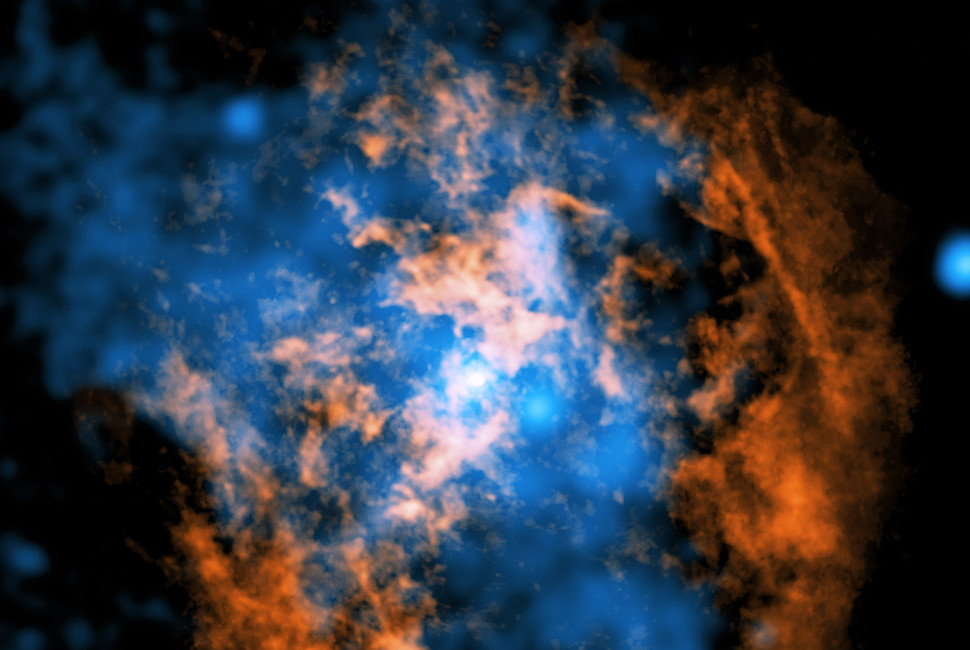
After more than 50 years of searching, astrophysicists at Northwestern University have finally discovered evidence of a powerful wind blowing from the Milky Way’s central supermassive black hole, Sagittarius A* (Sgr A*).
According to theoretical physics and a long-accepted understanding of galaxies evolution, as black holes consume materials, they should produce wind or jets. Even a small amount of gas falling into a black hole should generate enough energy to push material outwards. Without wind, Sgr A* would be a unique outlier.
But, until now, no one could find it.
By providing the most detailed view yet of how Sgr A* interacts with and transforms its surrounding environment, the scientists resolved one of the longest-standing mysteries in astronomy. It also opens a new window into the physics at play in the center of the Milky Way.
The study was published in The Astrophysical Journal Letters.
“Unless a black hole exists in a perfect vacuum, it must blow a wind somehow,” said Northwestern’s Mark Gorski, who co-led the study. “And there is no perfect vacuum in the universe. With new observations, this is the first time we’ve had a clean enough view to see the wind’s imprint. We looked at the data and said, ‘There it is. There is the thing that everybody’s been looking for for 50 years.’”
“We were the first to show that molecular gas very, very close to the black hole is feeding it,” said Elena Murchikova, who co-led the study with Gorski. “The wind is not powerful, and its direction probably wanders with time. It shows that our black hole is not unique, and our place in the universe is not unique.”