

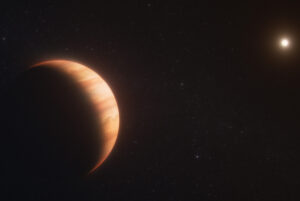
Artist concept of the gas giant planet WD1856b orbiting a white dwarf star. The planet is 7 times larger than the Earth-sized white dwarf it orbits. WD1856b has methane and hazes in its atmosphere, which would give it a similar colour to Saturn’s moon Titan. The white dwarf formed from a star that died 5 billion years ago and has been cooling ever since, giving it an orange colour similar to the Sun. Credit: NASA, ESA, CSA, Ralf Crawford (STScI)
When astronomers discovered a giant planet orbiting a dead star in 2020, they wondered how it survived its star’s violent demise. Now, observations from NASA’s James Webb Space Telescope (JWST) may finally explain the planet’s unlikely escape from destruction.
In a new study, an international team of scientists — including a Northwestern University astrophysicist — analyzed the planet’s atmosphere for the first time. Using measurements of the planet’s atmosphere, mass and temperature, the researchers reconstructed the planet’s journey. They found the planet (called WD1856b) originally orbited its star from a safe distance. But, billions of years after the star died, the planet migrated toward its dead companion.
The findings give an unprecedented glimpse into the distant future of planetary systems — including our own.
The study will be published on Wednesday (July 1) in the journal Nature.
“Our findings have bearing on the long-term fate of our solar system,” said study co-author Christopher O’Connor of Northwestern’s Center for Interdisciplinary Exploration and Research in Astrophysics. “In roughly five billion years, our sun will die, and we don’t know precisely what will happen to the planets at that time. The fact that planets can survive into that final stage of the stellar life cycle really widens the range of possibilities for where and when habitable planets might exist in the universe.”
O’Connor is a CIERA Postdoctoral Fellow at Northwestern, where he studies stellar and planetary astrophysics and dynamics. The study was led by Ryan J. MacDonald, a lecturer in extrasolar planets at the University of St. Andrews in Scotland.
READ THE FULL STORY IN NORTHWESTERN NOW.