

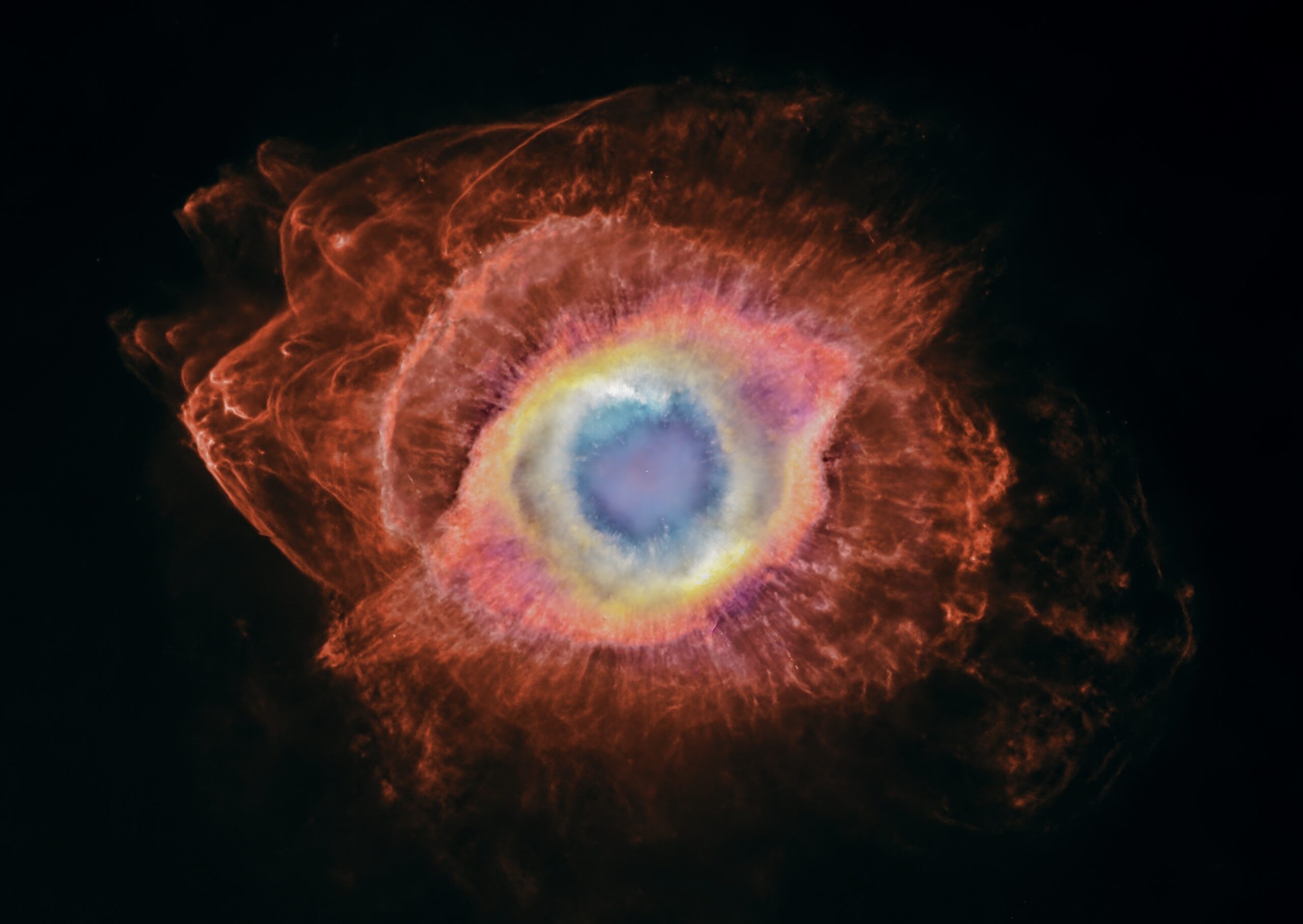
The Helix Nebula and the cosmic recycling of stellar material. The bright central nebula surrounds a white dwarf, the remnant of the star that created it. Farther out, newly revealed bow shocks show fragments of material cast off by that star colliding with surrounding interstellar gas. Credit for the previous data: NASA, ESA, C. R. O’Dell (Vanderbilt University) and M. Meixner, P. McCullough and G. Bacon (Space Telescope Science Institute). Credit for the combination of MOTHRA, Hubble and Kitt Peak data: Andrew McCarthy
An international team of scientists, including Northwestern University astrophysicists, has captured an unprecedented view of a dying star’s remains in the act of being recycled.
A striking new image of the Helix Nebula reveals a star’s fragments plowing through surrounding gas. By studying the image, astronomers traced the star’s debris as it is stripped, broken apart and gradually mixed into interstellar space. From there, the Helix’s material may one day become part of new clouds, new stars and perhaps even new planets.
The finding captures a long-elusive step in the cosmic recycling process that supplies raw materials for the formation of new planets and stars. It also offers a preview into the potential fate of our Sun, which eventually will shed its outer layers and return some of its own material to the Milky Way.
“We are seeing material shed near the end of a star’s life being broken apart and returned to the galaxy,” said Pieter van Dokkum, the study’s lead author. “That handoff — from recognizable stellar debris to the diffuse gas between the stars — has been very difficult to observe. Far in the future, the Sun will go through a similar process, and its material will enter the same cycle.”
An expert in galaxy formation and evolution, van Dokkum is co-founder of the Dragonfly Focused Research Organization (FRO), the Sol Goldman Family Professor of Astronomy and Physics at Yale University and a visiting scholar at Northwestern’s Center for Interdisciplinary Exploration and Research in Astrophysics (CIERA). In January 2027, he will join Northwestern as the Kimberly Querrey Professor of Astrophysics at the Weinberg College of Arts and Sciences.
READ THE FULL STORY AT NORTHWESTERN NOW →