
A groundbreaking large-scale simulation of the universe, created through a collaboration between Northwestern’s Center for Interdisciplinary Exploration and Research in Astrophysics (CIERA) and Argonne National Laboratory, was named a finalist for the 2025 Gordon Bell Prize, the highest honor in high-performance computing. It was one of only six finalists selected globally from hundreds of submissions across all fields of science and engineering. The award, administered by the Association for Computing Machinery (ACM), recognizes “outstanding achievement in high-performance computing,” and is considered the top prize in the field.
Interpreting the Universe
The project, involving CIERA and NSF-Simons AI Institute for the Sky (SkAI) faculty member Claude-André Faucher-Giguère, led to the development of The Frontier Exascale (Frontier-E), the largest hydrodynamic model of the universe ever achieved. 
“This is a simulation that starts from the Big Bang and simulates the evolution of a large portion of the entire universe, including dark matter, dark energy, and galaxies,” said Faucher-Giguère, Professor of Physics and Astronomy in the Weinberg College of Arts and Sciences. “Our new simulation contains one billion galaxies and is larger than the previous state-of-the-art worldwide by a factor greater than 10.”
The simulation was run on the Frontier supercomputer at Oak Ridge National Laboratory. Frontier is currently the top-ranked open science system globally, capable of performing more than one quintillion calculations per second.
What sets Frontier-E apart is not just its scale, but also its physical realism. Most previous simulations of the universe approaching a comparable scale assumed that the universe contained only dark matter. This simplification made the simulations much cheaper to run, but omitted crucial physical processes associated with the formation of galaxies.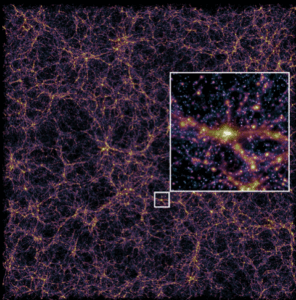
Frontier-E arrives at a pivotal moment in astronomy. With the recent launch of the Vera C. Rubin Observatory, home to the largest digital camera ever constructed, astronomers are poised to collect an astonishing 20 terabytes of data each night as part of the Legacy Survey of Space and Time (LSST), a decade-long campaign to map the dynamic universe. Frontier-E will be essential in decoding this massive influx of data, helping scientists unlock deeper insights into the structure and evolution of the cosmos.
A Team Effort
The project emerged from a decade-long interdisciplinary collaboration between physicists and computer scientists at Northwestern, Argonne National Laboratory, and additional partners at Oak Ridge National Laboratory. Faucher-Giguère and his group have extensive experience modeling galaxy formation, while Argonne has a long history of producing many of the largest simulations for cosmological studies, and optimizing them to utilize the most powerful supercomputers available. The new simulation combines both elements: the largest cosmic volume simulated to date with galaxy formation physics included.
The Argonne team includes Nicholas Frontiere, Salman Habib, Katrin Heitmann, J.D. Emberson, Michael Buehlmann, Esteban Rangel, Vitali Morozov, and Adrian Pope. Drs. Habib and Heitmann are also SkAI Institute faculty affiliates.
To produce Frontier-E, the team had to overcome enormous computational challenges, innovating new algorithms and performance optimizations to efficiently simulate a trillion particles representing dark matter and cosmic gas across cosmic time.
The data products from Frontier-E are expected to fuel a decade of new discoveries in astrophysics and cosmology. “To properly interpret the new observations, we need new computer simulations that are matched to the new telescopes,” Faucher-Giguère said. “We expect Frontier-E to be used for a wide range of scientific studies over the next decade—from new insights into the physics of rare cosmic structures such as galaxy clusters to enabling more precise measurements of dark energy.” The simulation is also expected to support emerging efforts in AI-driven astrophysics by providing a new foundation for training data-hungry machine-learning models.
“This project and its selection as a Gordon Bell Prize finalist are a significant achievement of a collaboration between Northwestern and Argonne initiated about a decade ago,” said Faucher-Giguère. “At Northwestern, we are experts in modeling the formation of galaxies, while the Argonne group has unique expertise in large-volume cosmological simulations and in developing highly optimized computer codes. By teaming together, we developed what is now, by an order of magnitude, the largest high-fidelity computer simulation of the universe and the galaxies that form in it.”
Featured Image: Rendering of a small fraction of the full Frontier-E simulation. The image shows how cosmic gas is distributed in the universe. This region, which is three billion light years across, is just half a percent of the total volume of Frontier-E and contains about 10 million galaxies. The full Frontier-E simulation is much larger and contains over a billion galaxies. The inset zooms onto a region where a cluster of galaxies is located.
by Lisa La Vallee