
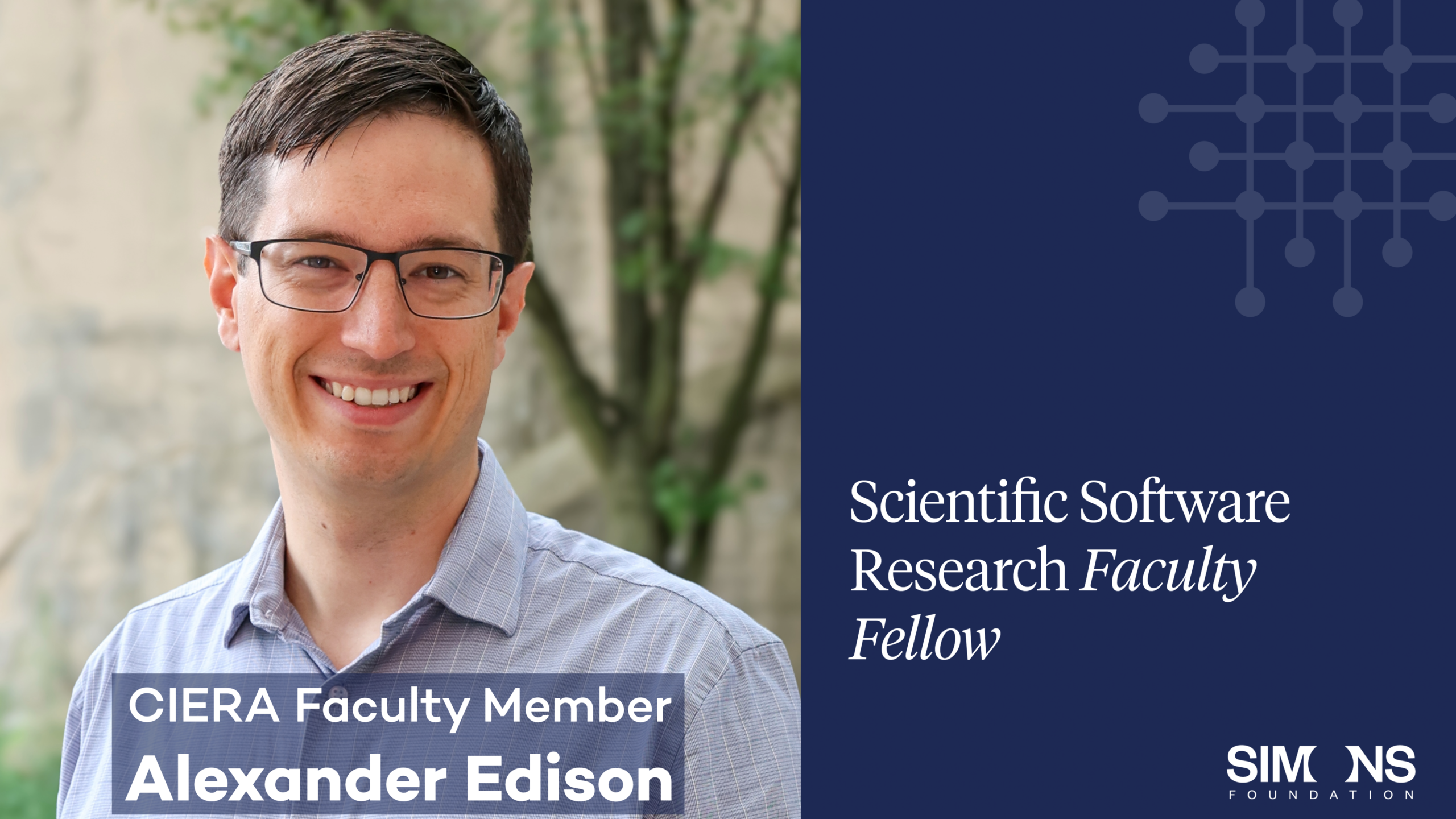
 The Simons Foundation has named Northwestern University’s Alexander Edison, research assistant professor in the Department of Physics and Astronomy, as a recipient of the prestigious Scientific Software Research Faculty Fellowship. Edison is also a member of the Amplitudes and Insights Group at Northwestern and a member of the Center for Interdisciplinary Exploration and Research in Astrophysics (CIERA).
The fellowship supports the creation of new, software-focused faculty positions at academic institutions. These roles are designed to enable researchers to develop advanced scientific and mathematical software that plays a critical role in modern discovery — powering data analysis, simulations, visualization and complex calculations.
In its announcement, the foundation highlighted Edison’s research “specializing in perturbative field theories with a particular focus on Yang–Mills and gravity. As a fellow, he will develop a robust, open-source framework for generalized unitarity methods and double-copy constructions in quantum field theory that will bring together various QFT concepts with specialized graph-theoretic manipulations and polynomial and rational algebra.”
Scientific Software Research Faculty Fellowships provide the fellows’ home institutions with 50 percent salary and benefits support to establish these new positions. In addition, each fellow will receive a $50,000 research allowance to advance their work. The fellowships are funded by Simons Foundation International and administered by the Simons Foundation. Through this program, the foundation seeks to strengthen core scientific software infrastructure in academic environments and establish a sustainable, long-term, faculty-level career path for researchers whose primary focus is scientific software development.
“I am extremely excited and honored to have been chosen as a Scientific Software Research Faculty,” Edison said. “This award will elevate my research at Northwestern and CIERA, and enable much-needed effort to improve the open-source ecosystem in my corner of science.”