
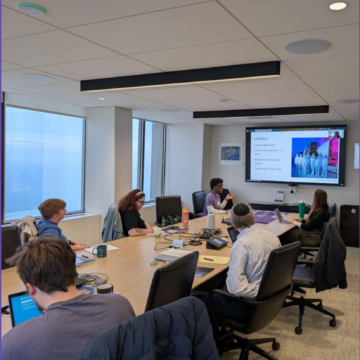
To support teachers within the local Chicagoland community, CIERA hosts professional development workshops for STEM CPS teachers. In addition to offering Illinois State Board of Education Professional Development hours, we provide teachers with relevant talks on space science, activities and resources that can be used in the classroom, and an opportunity to network with other local educators. Our workshops are free and open to all teachers!
Past Teacher Workshops |
|
Bringing the Universe to Your Classroom: A Professional Development Workshop for STEM TeachersGideon McFarland, Lindsay House |
With the launch of new telescopes and the advent of AI, the field of space sciences has been rapidly evolving. This professional development workshop, hosted by the Northwestern University Center for Interdisciplinary Exploration and Research in Astrophysics (CIERA), will help teachers learn the latest news about space, answer questions their students have been asking, network with other educators, and receive resources from CIERA and their peers. Teachers from across all STEM fields, such as Earth and space sciences, chemistry, computer science, and physics, are encouraged to join! During the workshop, you will hear from Gideon McFarland, an astronomy graduate student at Northwestern University, about the latest “hot topics” in space science, such as 3I/ATLAS, Rubin Observatory, and the launch of SPHEREx. In addition, Lindsay House, a postdoctoral preceptor at the NSF-Simons AI Institute for the Sky, will give a talk about her research. She is the project lead for the NASA Zooniverse project, Dark Energy Explorers, which engages the public in labeling galaxies using the third-largest telescope in the world. Her talk will delve into how she uses those labels to inform machine learning models and learn about dark energy and the expansion of the universe. |
Professional Development Double Feature: A Day in the Life and Spectroscopy in the ClassroomMaia Martinez, Genevieve Schroeder, Kyle Rocha, Peter Podlipni, Joseph Seabloom |
In honor of professional development week, we will be having a double feature presentation. In the morning, we’ll hear about what day to day life is like in the field of astronomy from the perspective of both an observer, Genevieve Schroeder, and a theorist, Miguel Martinez. We’ll hear about the primary skills, knowledge, and tasks required to do research in two different areas of the field of astronomy. Finally we’ll hear from Peter Podlipni (Jones College Prep), a past participant in CIERA’s Research Experience for Teachers program and learn how research experience can be brought back and applied to the classroom. After lunch, we’ll hear about the development of a new Baxter Box item, the spectrometer lab, developed by Kyle Rocha. We’ll be treated to a discussion about the uses of spectroscopy and a live demonstration of the new activity. We’ll also have the opportunity for final suggestions for modifications before it goes live for you all to use. We’ll also hear from Joseph Seabloom, High School Science Support Specialist at Chicago Public Schools, about professional learning communities and how this cohort can continue beyond this workshop series, as this will be the final scheduled workshop for this year. |
Spoiled by Big Data? Citizen Science to the RescueMaia Martinez & Jennifer Sanchez |
Though physics and astronomy are famous for the construction of relatively simple mathematical models to describe reality, the real world isn’t always so simple. When real-world data can’t be classified and processed by some automated pipeline, then a human judgment is still needed. As our instruments get better and better, we are simply overwhelmed with data and so it becomes too much for a small team to handle. This is where citizen science comes in. In this workshop, we will look at two examples of citizen science projects from the Zooniverse platform, Planet Hunters and Gravity Spy, and how they have enabled the progress of science in exoplanet and gravitational wave detection respectively. Following the presentation, we will have an open discussion about astronomy topics, tools, and strategies you all are using in your classroom. |
The Death and Afterlife of StarsMaia Martinez |
While humanity has been gazing at the stars for millennia, it’s only recently that we’ve begun to understand what happens when their light gets snuffed out. In this talk, I will describe the various ways that stars still shine even after their death, with a focus on electromagnetic observations (light) all the way from 1054 AD to the present. I will discuss some of the implications these events have for life on Earth, including the origin of precious metals in the Universe and the evolution of life on Earth. |
Whispers from the Dark: Black Holes and Gravitational Wave AstronomyFrom The 2023 Baxter Symposium |
Of all the exciting phenomena in the Universe, none have the propensity to excite and confuse the human imagination as much as the elusive black holes, those objects from which nothing, not even light can escape. But if nothing can escape a black hole, how do we know they’re there? In the past, black holes were studied mostly from the light of stellar companions. However, starting in 2015, a new window on the Universe has been opened with the advent of gravitational wave astronomy. In this session, I will give a short overview of the theoretical description of black holes, attempt to clear up some common misconceptions, and describe what gravitational waves are and where they come from in the Universe. I will present a classroom activity that demonstrates how scientists extract information about astrophysical black holes from gravitational wave detectors. The materials used will be made freely available to attendees. |
Measuring the Temperature of the Sun with Student DataFrom The 2023 Baxter Symposium |
Become an astronomer and measure the temperature of the sun with this activity! Students take their own solar spectrum and find the wavelength of peak emission. Students will learn core physics concepts including spectral analysis, emission mechanisms, data analysis, and stellar evolution. |