
CIERA’s fifth annual event blended a public lecture, hands-on activities, and telescope viewing at Dearborn Observatory
By Matt Golosinski
Photo credits: Bonnie Robinson
 Hundreds of community members, students, families, and astronomy faculty and enthusiasts gathered at Northwestern University on May 28 for CIERA’s fifth annual “Astronomy Night Out,” a free public program that brings the wonder of discovery beyond the laboratory and into the broader community. More than 400 attendees participated in person and via livestream.
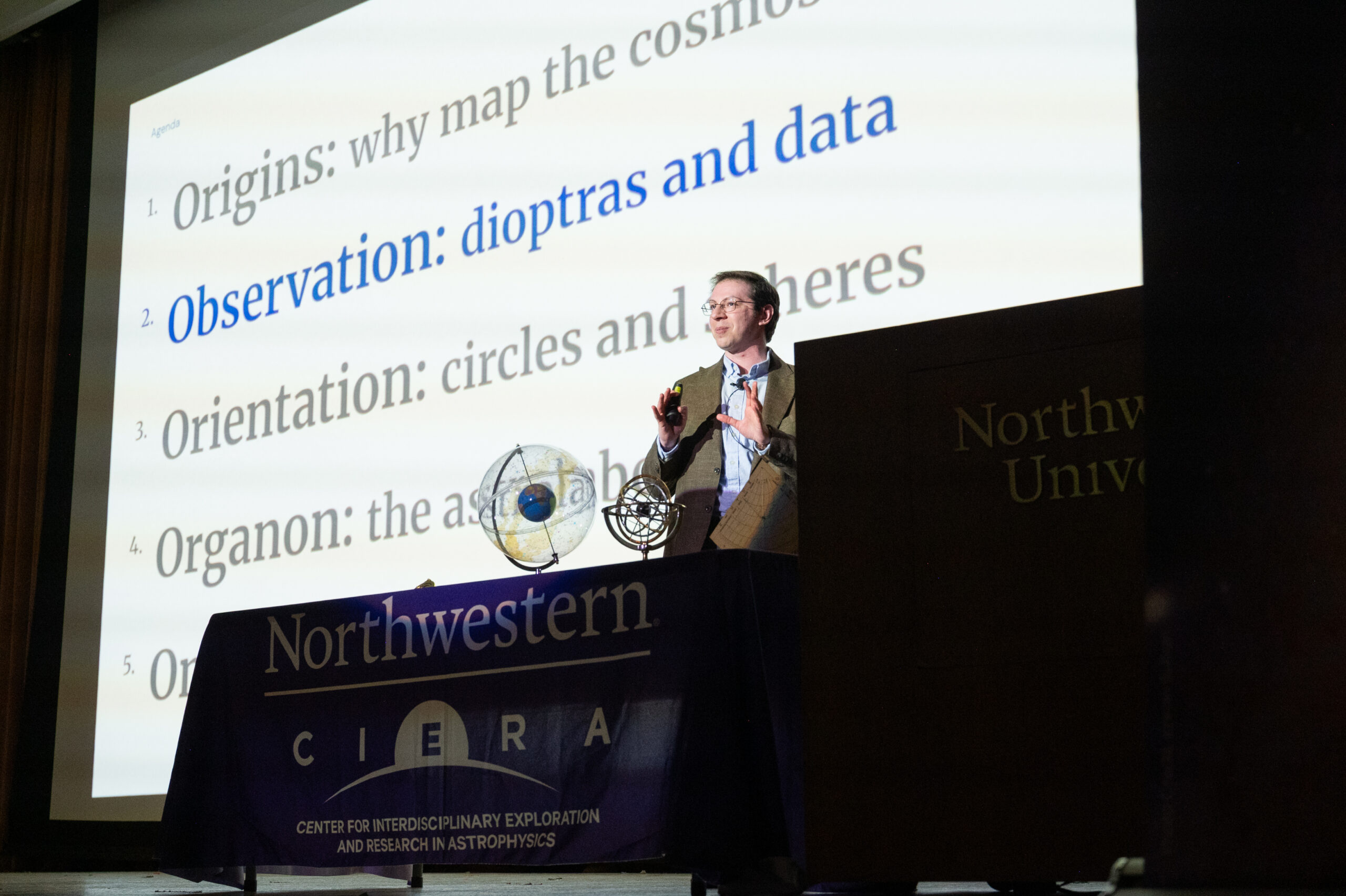
Hosted by Northwestern’s Center for Interdisciplinary Exploration and Research in Astrophysics (CIERA), the evening featured a keynote lecture by Northwestern Assistant Professor of Classics and CIERA faculty member Nick Winters titled “Heavenly Spheres: How Ancient Greece and Rome Mapped the Cosmos.” A classicist and former physicist who studies ancient mathematics and science, Winters examines how scientific knowledge moved through the ancient world—and how mathematical practices evolved across cultures and generations. His research has challenged traditional understandings of Greek mathematics by reading ancient texts as interconnected networks of information exchange and method.
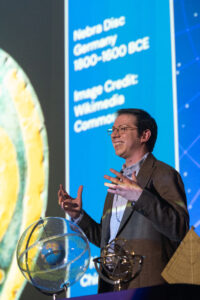
Winters’ talk traced how civilizations understood celestial motion long before modern telescopes and computational astronomy, drawing connections among mythology, mathematics, philosophy, and observational science. The program also underscored a defining strength of CIERA and Northwestern’s research ecosystem: meaningful collaboration across disciplines that might otherwise seem worlds apart. In this case, a center best known for astrophysics and cosmology partnered with scholarship rooted in the ancient Mediterranean to explore humanity’s enduring fascination with the night sky.
The evening began with Winters’ public lecture in Ryan Auditorium at Northwestern’s Technological Institute and expanded into a campus-wide experience, including telescope viewing at nearby historic Dearborn Observatory, hands-on astronomy activities for families and children, and demonstrations featuring replicas of ancient astronomical instruments. Throughout the night, CIERA scientists and students answered questions and spoke with visitors in informal conversations about space and the science behind what they were seeing. Among those participating were members of The Chicago Astronomer, Code Your Dreams, National Hellenic Museum, Northwestern Classics students, CIERA’s astrophotographer Imran Sultan, and CIERA’s Gravity table
In his lecture, Winters described how Greek and Roman thinkers developed increasingly sophisticated approaches to mapping the heavens, blending empirical observation with mythology, mathematics, philosophy, and (at times) political power. Long before satellites and GPS, many societies relied on celestial knowledge for navigation, agricultural planning, seasonal prediction, and maritime travel.
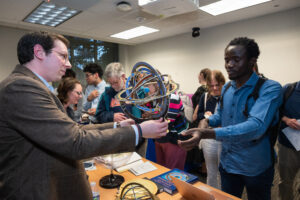 Among the instruments highlighted was the astrolabe, used to measure celestial positions and solve navigational and mathematical problems. Winters called it “the coolest device I get to teach about,” describing it as both “a map and a portable computer” that left earlier models such as the armillary sphere “in the dust.”
“This thing is a masterwork of projection geometry,” Winters told the audience. “It’s a portable, storable map and a tool for making new observations, new catalogs of stars and the cosmos.”
Winters also explored the social and political significance of astronomical knowledge. In many societies, the ability to interpret celestial movements reinforced the authority of the ruling and priestly classes, shaping religious rituals, civic decision-making, and broader ideas about order in the world.
Standing before a projected image from the James Webb Space Telescope near the end of his lecture, Winters reflected on why the history of astronomy still matters.
“You can’t appreciate today’s celestial imagery without understanding all the work that it took to get to this point,” he said. “All the calculations and labor and mechanical work of those who made these precise and beautiful tools. This is a rich history worth appreciating.”
Since launching in 2022, Astronomy Night Out has become one of CIERA’s signature public outreach programs, drawing hundreds of guests annually. Previous events have featured Northwestern researchers discussing topics ranging from gravitational waves and pulsars to discoveries enabled by the James Webb Space Telescope and explorations of the Milky Way.
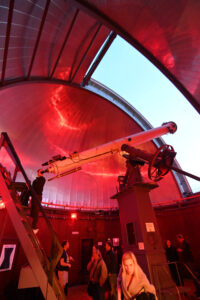 Beyond showcasing current research, organizers say the series invites the public onto campus to participate directly in discovery, demystifying complex topics through accessible conversation, hands-on learning, and the shared experience of observing the night sky.
CIERA is one of roughly two dozen University-wide research institutes and centers that connect faculty, students, and researchers across Northwestern’s schools and departments in pursuit of interdisciplinary discovery. The center brings together researchers working across astrophysics, cosmology, gravitational-wave science, planetary science, data science, and artificial intelligence-enabled astronomy.
CIERA faculty have contributed to major advances in astrophysics over the past decade, including research tied to the landmark confirmation of gravitational waves—work that opened a new way of observing the universe. Today, the center continues to push into emerging frontiers, from machine learning applications in astronomy to next-generation observatories, computational astrophysics, and multi-messenger studies of black holes and neutron stars. CIERA’s faculty includes internationally recognized researchers such as astrophysicist and CIERA Director Vicky Kalogera, whose work has helped position Northwestern as a leading hub for gravitational-wave and compact-object astrophysics. CIERA scientists collaborate extensively with major national and international initiatives, including LIGO and projects connected to the James Webb Space Telescope, the Keck Observatory, and the Giant Magellan Telescope.
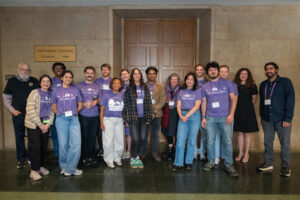 For attendees, Astronomy Night Out offered both intellectual exploration and simple wonder—an opportunity to move from discussions of ancient star maps to direct observation of the night sky through telescopes on Northwestern’s campus.
“What makes CIERA unique is not just how it connects different areas of research and across disciplines, but how it opens that connection to people — creating opportunities for the broader community to engage with and feel inspired by scientific discovery,” said CIERA Assistant Director and Research Assistant Professor Tarraneh Eftekhari.
The free event drew attendees from across Evanston and the greater Chicago region, continuing CIERA’s effort to make astronomy accessible, engaging, and deeply connected to the broader human experience.