

Francesca Valsecchi, Ph.D. Angus Forbes, Ph.D.
Former member of the Center for Interdisciplinary Exploration and Research in Astrophysics (CIERA), Francesca Valsecchi, Ph.D., as well as CIERA Tech Council Member, Angus Forbes, Ph.D., recently visited CIERA for the CIERA Connections speaker series to share how research experience facilitated their transition from academia to their respective data and computer science industry careers.
Over 30 graduate and postdoctoral students attended both Valsecchi’s presentation on April 27 and Forbes’ on May 11. Both speakers emphasized the importance of flexibility, building a wide network of connections, and interdisciplinary skill application.
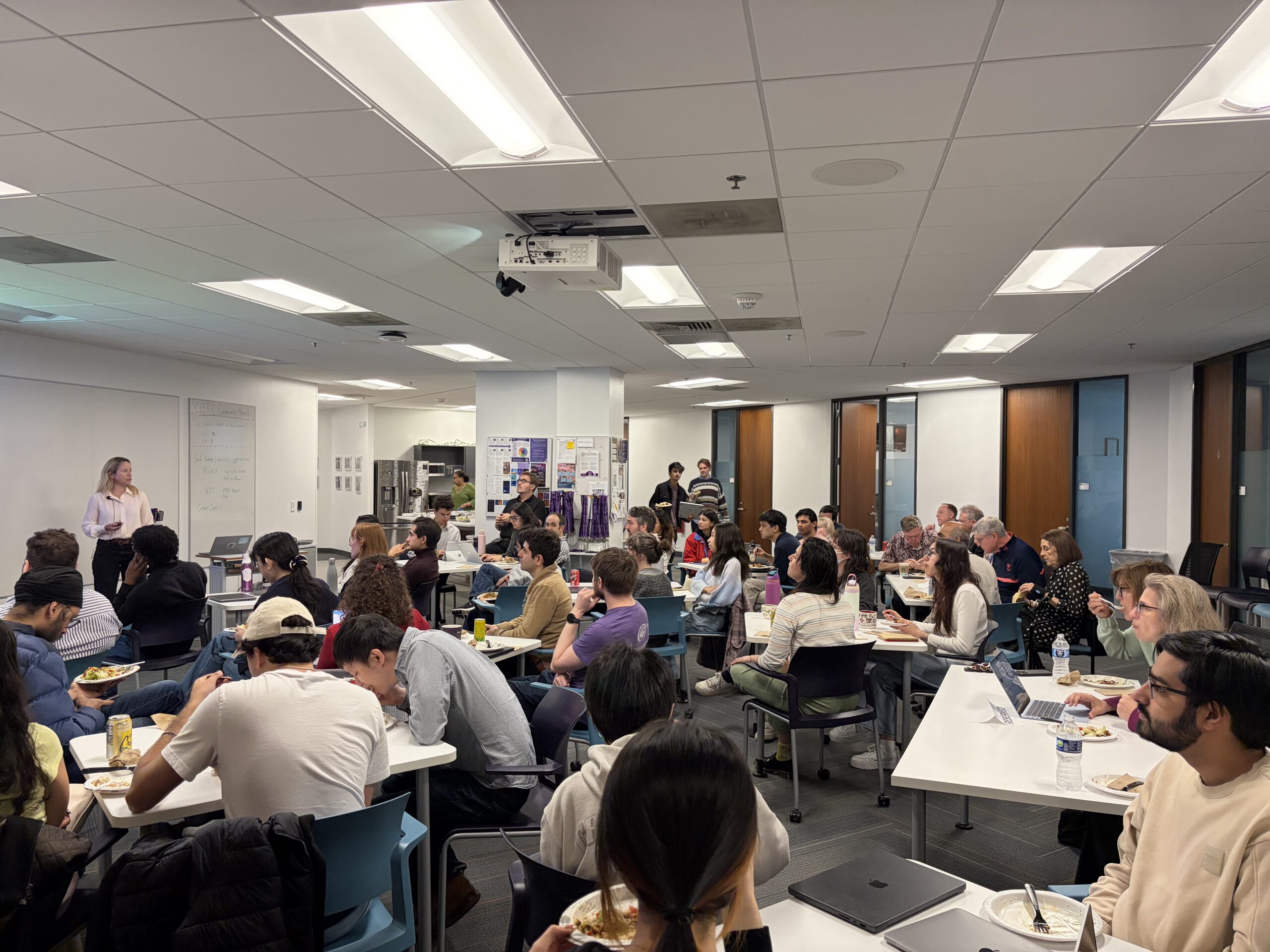
Francesca Valsecchi presenting at CIERA Connections on April 27, 2026.
After earning both her M.S. and Ph.D. in Physics and Astronomy from Northwestern University, Valsecchi spent three years on the academic job market before ultimately turning down postdoctoral research offers to take her knowledge to the tech startup world. Now an independent data science consultant, Valsecchi has worked on computer models to detect fraud in healthcare and advised companies building their own data science teams, drawing from her experience as the Data Science Lead at Planet FWD, an environmental sustainability-focused company that helps consumer brands measure their carbon footprints. Valsecchi remembers the stress and uncertainty of being one of many postdoctoral students applying to few positions—and she doesn’t regret her decision to step away and find where she really thrives.
“There is still this view that if you don’t stay in academia, you failed it, which shouldn’t be the case. I didn’t fail academia,” said Valsecchi. “All that commitment taught me the skills and knowledge I could reuse in other places.”
While many speakers discussed the technical aspects of their fields, Valsecchi said she wanted to convey how her work feels: exhausting, yet exciting. Just as leaving academia did not at first feel like a natural next step, the social networking required for her career does not come easily to Valsecchi. However, she said this challenge should not deter academics who are interested in pursuing industry jobs.
“It’s a learned skill, and these students learn way more complicated things,” said Valsecchi. “Graduate school teaches you that you can learn everything you need to learn to do whatever you need to do.”
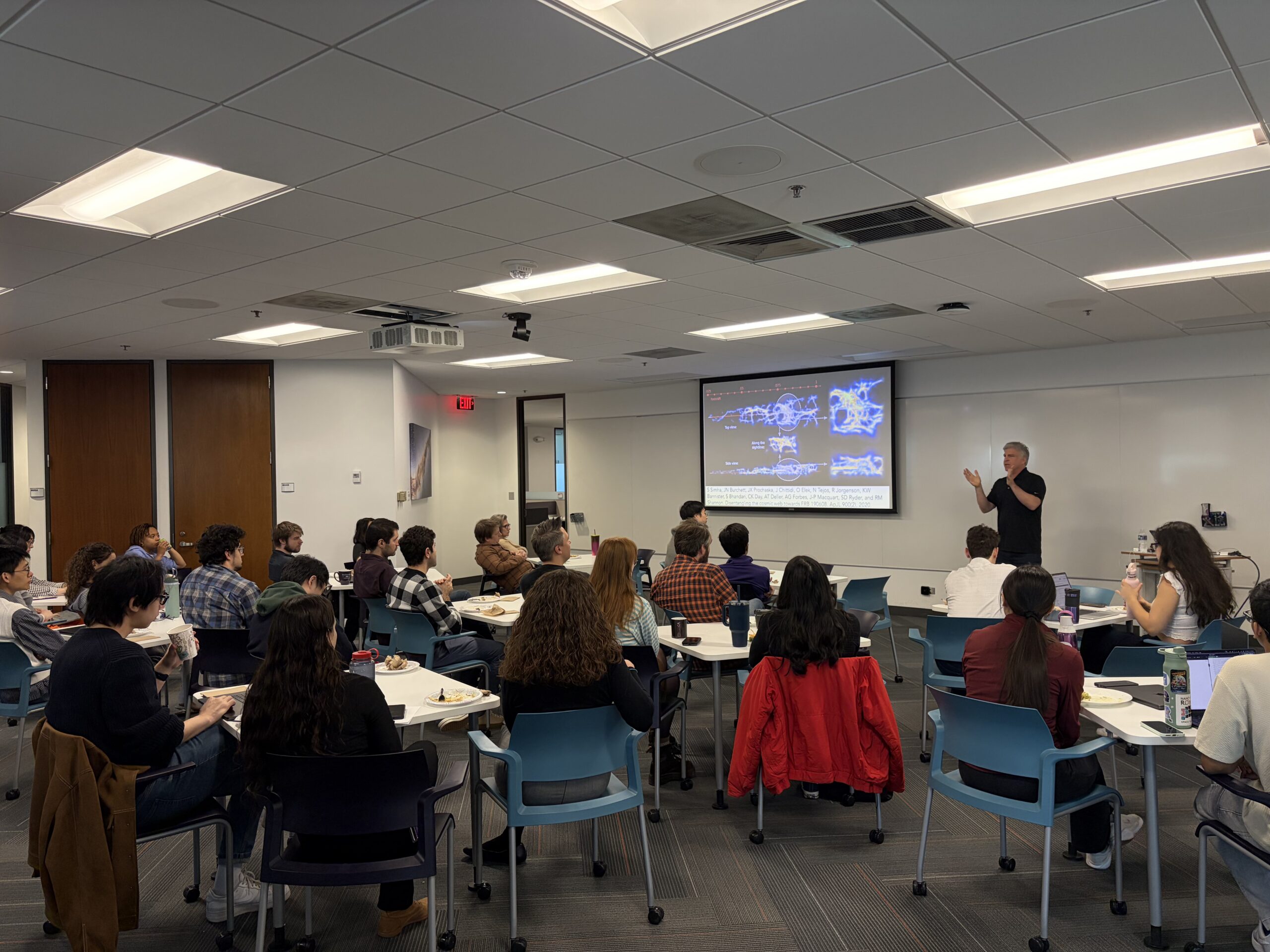
Angus Forbes presenting at CIERA Connections on May 11, 2026
Angus Forbes navigated between roles in and out of academia—from studying literature as an undergraduate, to working as a programmer for startup companies, to earning a Ph.D. and becoming a tenured professor—before taking a Senior Scientist position on the Strategic Research Collaboration team at NVIDIA.
Forbes stressed that there is no single profile of a successful scientist; the data analysis and critical thinking skills he honed for years as an academic are now critical to his work building AI computer tools for the highest-valued company in the world.
“The academic experience is very valuable even outside of academia,” said Forbes. “There are many paths to success.”
After explaining the array of industry job titles that require a master’s or doctoral degree for complex problem solving, Forbes encouraged students to seek roles beyond “Research Scientist,” and gave one-on-one advice about possible career trajectories.
For the first time, members from the CIERA Board of Visitors attended the event, with founding member Dianne Blanco joined by former Provost of Northwestern University Daniel Linzer, as well as lead of NASA Space Apps Chicago Don Crowley, and other board members, for Valsecchi’s presentation.
Peter Anglada, chairperson of the organizing committee for CIERA Connections and CIERA’s Senior Financial Administrator, said that the speakers are meant to help students be realistic about their future and demystify the process of transitioning out of academia and into industry, turning a CV into a resume.
“In a job interview, if a student is asked, ‘What is your experience?’ they may think they don’t have any, because they have always been in academia. But they do,” said Anglada. “Programming, data analysis, presentation skills, and leading a research team are all useful job skills.”
About CIERA Connections
CIERA Connections is organized by the Center for Interdisciplinary Exploration and Research in Astrophysics, in which STEM graduates talk about their chosen non-academic careers. CIERA Connection topics are intended to cover a wide range of career paths, such as Research Computing, Data Science, and more. The purpose of this series is to provide junior researchers with exposure to career opportunities outside academia. Speakers with a graduate degree (e.g., in physics, astronomy, or related fields) are invited to talk about their chosen non-academic careers. Events include opportunities for graduate students and postdocs to meet one-on-one or in smaller groups with the speaker before or after the talk.
by Georgia Kerrigan