

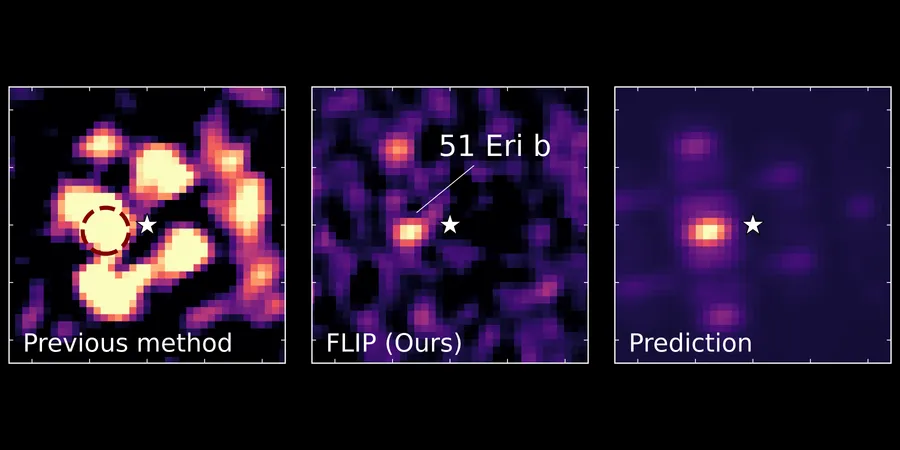
A new technique developed by CIERA members Rodrigo Ferrer-Chavez and Jason Wang cuts through the glare of starlight in James Webb Space Telescope (JWST) images, revealing a giant planet that standard image processing could not see.
The method, called Physics-based Learning for Imaging Planets (FLIP), builds a “digital twin” of the telescope that simulates how starlight travels through its mirrors, including tiny imperfections that change from moment to moment. Tested on JWST observations of three stars, FLIP improved sensitivity to faint planets by 2 to 15 times and detected the known giant planet 51 Eridani b in two-year-old data, where conventional processing could not distinguish it from residual glare. The study was published Nov. 4 in Nature.
“Planets are a million times fainter than their stars,” said Ferrer-Chavez, a Ph.D. student in astronomy who led the study. “Our method models how light travels through the telescope and accounts for those tiny changes, allowing us to remove the glare much more precisely.”
Wang, an assistant professor of physics and astronomy, noted that the team used the same computational tools used to train AI models, “but we did not actually use AI.” The advance could help astronomers find smaller, colder and fainter planets without changing telescope hardware, and may inform the design of NASA’s proposed Habitable Worlds Observatory.
Read the full story on Northwestern Now
In the news: NASA’s James Webb Space Telescope Is Wobbly. Scientists Have a Fix That Could Reveal New Alien Worlds, Scientific American