
Clearest evidence yet that giant planets spin faster than their cosmic lookalikes
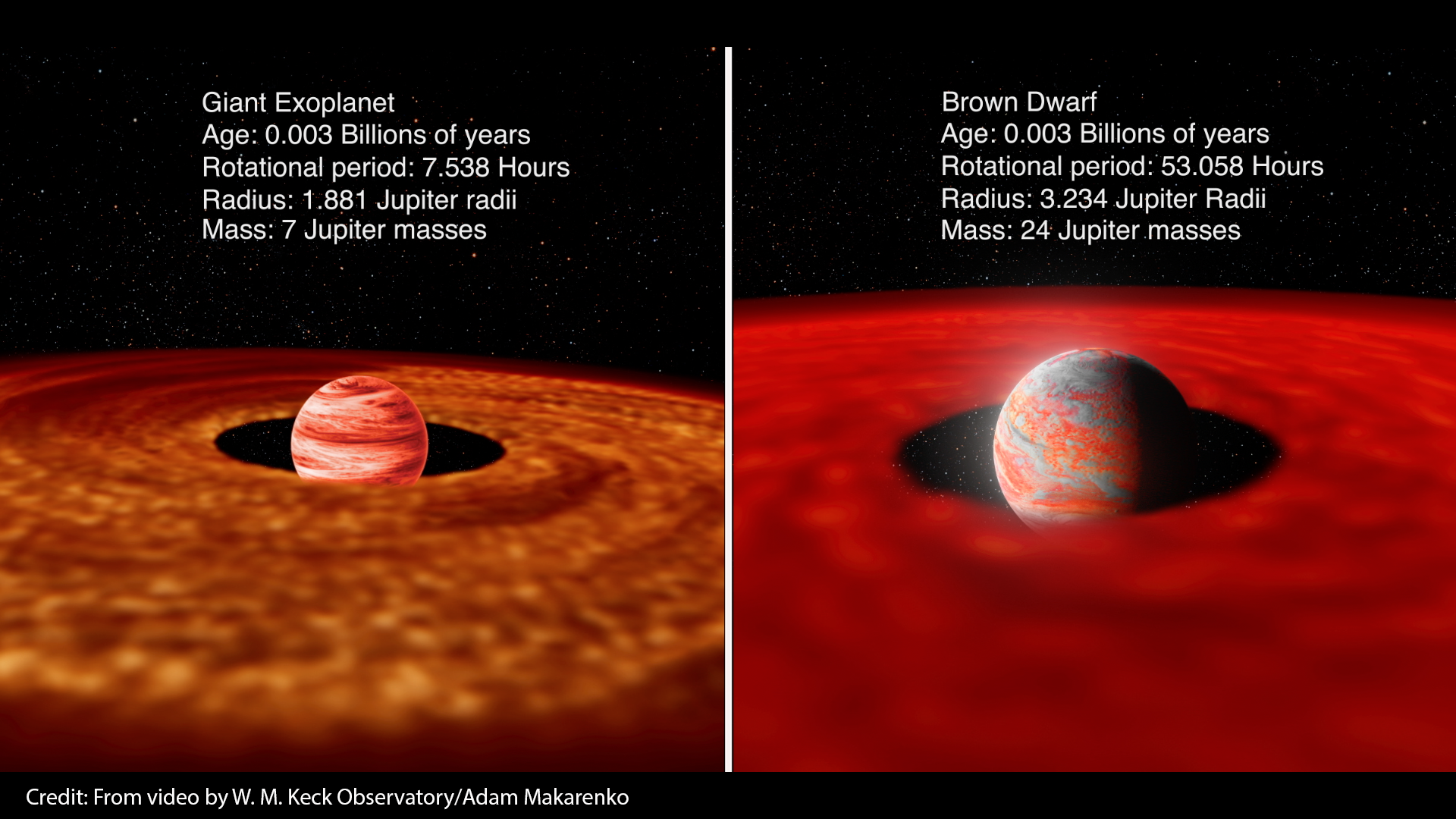
For decades, astronomers have struggled to differentiate giant planets from brown dwarfs, a class of objects more massive than planets but too small to ignite nuclear fusion like true stars.
Through a telescope, these cosmic lookalikes can have overlapping brightness, temperatures and even atmospheric fingerprints. The striking similarity leaves astronomers unsure if they have observed an oversized planet or an undersized star.
Now, a Northwestern University-led team has uncovered a crucial clue that separates the two: how fast they spin.
In a new study, astrophysicists found the clearest evidence yet that giant planets spin significantly faster than their brown dwarf counterparts. The new results suggest rotation measurements may provide a powerful new diagnostic for classifying these indistinguishable populations and suggest that these two objects evolve differently, perhaps even forming through distinct processes.
The study will be published on Wednesday (March 18) in The Astronomical Journal. It marks the largest survey of spin measurements of directly imaged extrasolar planets and brown dwarfs to date.
“Spin is a fossil record of how a planet formed,” said Northwestern’s Chih-Chun “Dino” Hsu, who led the study. “By measuring how quickly these worlds rotate, we can start to piece together the physical processes that shaped them tens to hundreds of millions of years ago.”
An expert on exoplanets and brown dwarfs, Hsu is a postdoctoral researcher at Northwestern’s Center for Interdisciplinary Exploration and Research in Astrophysics (CIERA), where he is advised by study coauthor Jason Wang. Wang is an assistant professor of physics and astronomy at Northwestern’s Weinberg College of Arts and Sciences and a member of CIERA.