
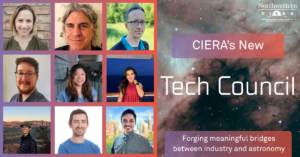
The Center for Interdisciplinary Research and Exploration in Astrophysics (CIERA) Tech Council had its inaugural meeting April 13. The new 9-member group will build bridges between astronomy and industry through collaboration, mentorship, and events. The members are industry professionals, many with a background in astrophysics, currently working in organizations ranging from Google, Northwestern Medicine, Slingshot Aerospace, and more.
Council members will engage with CIERA in a variety of ways, such as providing mentorship for CIERA students considering a transition out of academia and facilitating research collaboration between CIERA and industry. Board of Visitors Research Associate Alexandra Mannings serves as the council’s Program Coordinator and Post-Baccalaureate Research Fellow Caleb Krueger as Assistant Program Coordinator.
Together they developed the vision for the council, including the mix of member skills, experiences, and perspectives that such a group would need.
“The creation process definitely did start with finding people that fit the bill before even defining what the bill was,” said Krueger. “It was people who were astrophysicists or were astrophysics-related grad students and academics that are now in industry and also ones that have some sort of connection to Northwestern.”
The idea for the council came when Board of Visitors member Don Crowley listened to an episode of the “Astronomers Turned Data Scientists Podcast.” The episode featured inaugural Tech Council member Julie Hollek, who Crowley knew from her role as a judge in NASA Space Apps Chicago. Crowley serves as the local lead for Space Apps, a hackathon for high school and college students.
In the podcast, Hollek, who received her Ph.D. in Astronomy from The University of Texas at Austin, told her story of transitioning away from academia and into the data science field. Crowley proposed establishing a network of people who had followed similar career paths not just to provide guidance to those at CIERA considering the switch but also to facilitate further connection between the two groups.
Hollek currently is the Chief Technology Officer at HumaneIntelligence, which evaluates AI models to make them more accountable and fair. Holleck works with her team to build out AI evaluation infrastructure, with her astronomy background still being relevant.
“Astronomers make great data scientists because in order to collect data, they go outside and take what the night sky will give them. From there they mine that data for physics. This is very true of what a lot of data science roles have looked like for me in the past, but the underlying distributions change from gaussians to power laws,” said Hollek. “I first learned how to really own and drive a project from start to finish in astronomy, extending far beyond just writing code.
Crowley also contributed to the initial list of candidates for the council, drawing on professionals in the science and tech fields he had met through Space Apps. Mannings and Krueger researched what synergies existed between the candidates and what industries they wanted represented before sending out invitations.
The inaugural members come from the tech, healthcare, aerospace, digital media, and federal research fields. During the first meeting Mannings and Krueger shared what they envisioned the council’s role being before inviting members to share what they wanted out of the group.
“We did some crafting of the mission for the council, collaboratively discussing that, thinking more deeply about kind of why we were all there,” said Mannings. “It was nice to hear why they decided to be there, and so many of them were really excited to share their experience, to share their expertise, and have that really valued.”
Kruger said that a goal of the Tech Council will be to emphasize the interdisciplinary aspect of the Center for Interdisciplinary Research and Exploration in Astrophysics. Rather than just focusing on academia, the Tech Council shows the wide variety of industries an education in astrophysics can lead to.
However, once someone has made the switch, their connection to academia doesn’t have to end. Krueger explained that there is significant collaboration between both, such as algorithms developed by astrophysicists to identify stars later being used by tech companies to make AI chatbots. The council will facilitate these research partnerships by helping CIERA members acquire, use, and develop tools such as AI for astronomical research.
“There is this kind of back and forth relationship that almost feels like giving each other hand-me-downs, like, ‘we’ve developed this new instrumentation that we think would be great for gaming, and then astrophysicists are like, hey, we can make a really awesome supercomputer out of that stuff to do our simulations’”, said Krueger. “It’s an interesting relationship that doesn’t necessarily go in the same direction at the same pace, but ultimately, in one way or another can benefit both parties.”
The inaugural council members include Margaret Creagh and Zach Hafen-Saavedra representing the healthcare industry, Angus Forbes, Julie Hollek, and Megha Manglani from various tech companies, Christina Paton and Alex Post representing the aerospace sector, as well as Lucas Secco and John Fregeau from the digital media and federal research categories, respectively.