

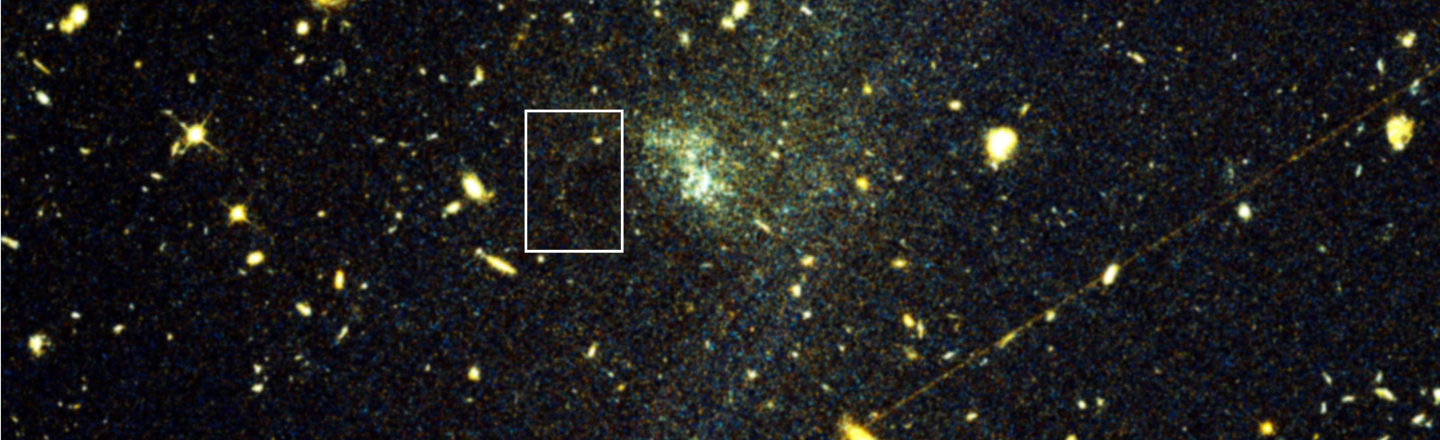
A NASA Hubble Space Telescope image with box added to show location of the globular cluster stellar stream.
Update (Aug 14, 2026): This research was recently featured by CNN.
For billions of years, an ancient star cluster has been slowly unraveling, leaving behind a delicate ribbon of stars. And now it’s finally giving up its secrets.
Discovered by an international team of scientists, including a Northwestern University astrophysicist, this faint trail of stars is the first stellar stream of its kind ever identified outside the Milky Way. Astronomers have long expected such streams to exist in other galaxies, but, until now, had never observed one.
The discovery also provides a powerful way to study dark matter — one of the greatest unsolved mysteries in modern astrophysics. By modeling the stream’s shape, the research team reconstructed the galaxy’s gravitational field and, in turn, inferred how dark matter shaped the stars’ orbits.
“The stars in a stellar stream all travel along nearly the same orbit, and that orbit is shaped by the galaxy’s gravity,” said Northwestern’s Tjitske Starkenburg, who coauthored the study. “By modeling that gravity, we can estimate the galaxy’s total mass. We already know roughly how much of that mass comes from visible matter like stars, so the rest must be dark matter.”
An expert in extragalactic astronomy, Starkenburg is a research assistant professor at Northwestern’s Center for Interdisciplinary Exploration and Research in Astrophysics. The study was co-led by Julie Kiel Holm of the University of Copenhagen and Sarah Pearson of the Technical University of Denmark.
READ THE FULL STORY IN NORTHWESTERN NOW →