
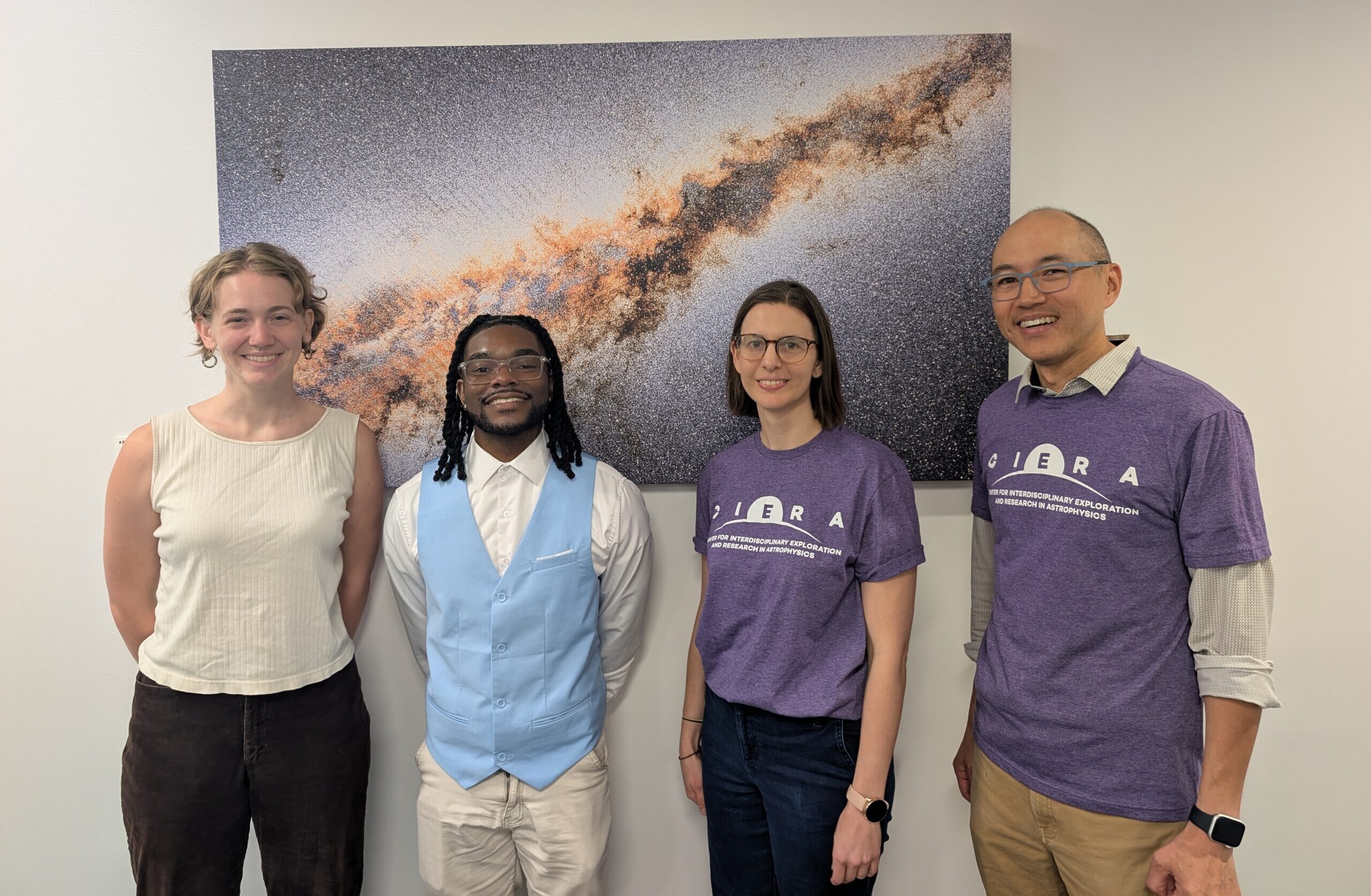
From left: Emily Wentorf, Michael Dixon, Kathryn Schoedel, Brian Huang
With students on summer break, four Chicago educators became the learners for the six-week Research Experience for Teachers (RET) program at the Center for Interdisciplinary Exploration and Research in Astrophysics (CIERA).
The program, funded in part by the National Science Foundation (NSF), pairs local STEM teachers with CIERA mentors to conduct original astrophysics research and develop curricula that translate their research knowledge and learned skills into content for their students.
CIERA Education and Outreach Coordinator James Schottelkotte said the program gives educators coding skills and the unique opportunity to engage with the same data CIERA researchers are investigating, while also being an opportunity for personal growth.
“The program is a time to reflect on and reinforce their interest in STEM,” Schottelkotte said. “The teachers then build that excitement into the upcoming year’s curriculum.”
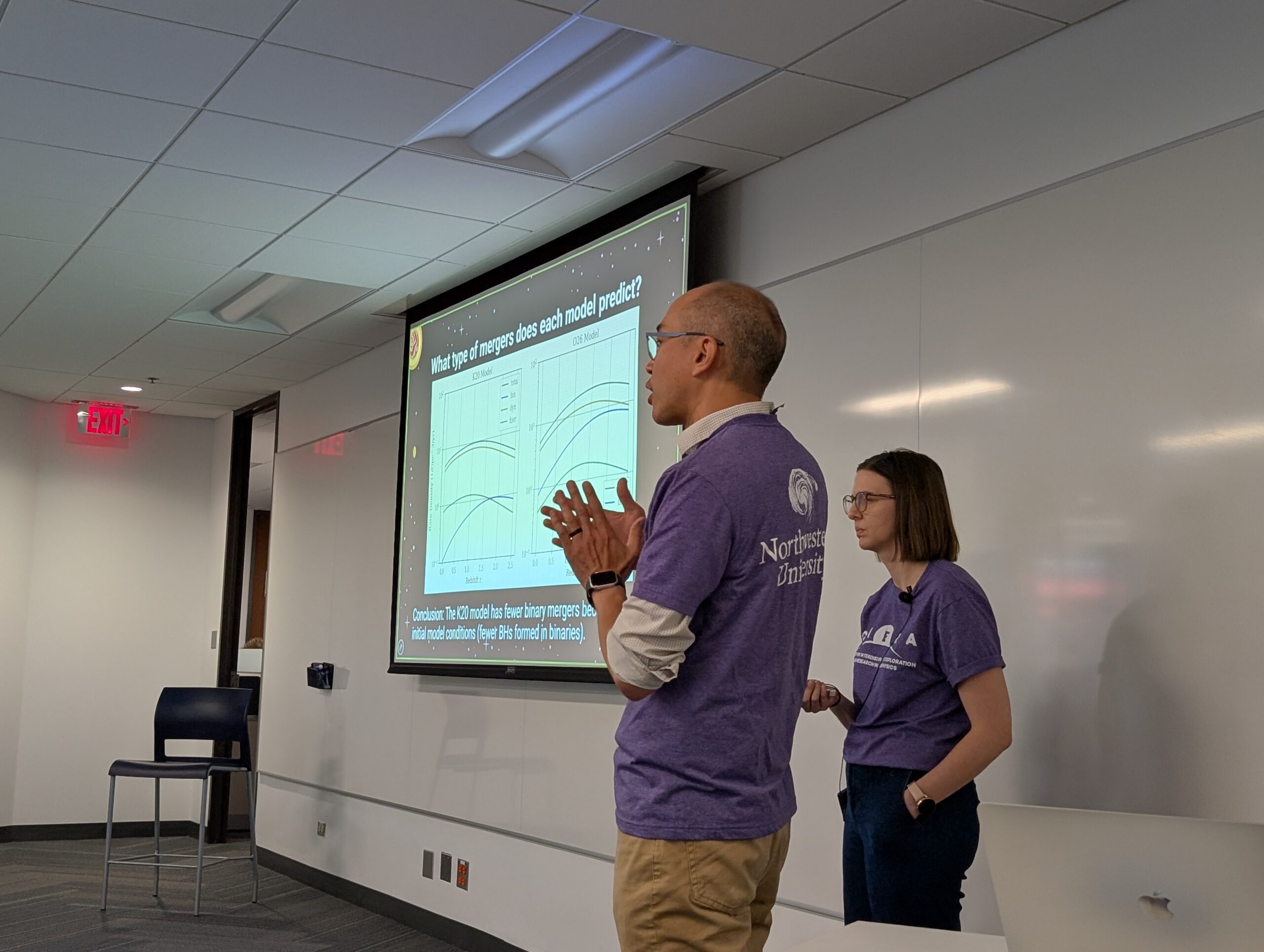
Brian Huang and Kathryn Schoedel presenting their research and curriculum plans at CIERA.
After scientific computing tutorials in Python, lectures by CIERA scientists, telescope observation at Dearborn Observatory, and curriculum-development workshops, the four educators presented their research projects and curricula at CIERA.
Participant Brian Huang started teaching in 2008, in subjects including engineering, computer science, robotics, physical science, and, for the past three years at Von Steuben Metropolitan Science Center, AP Physics. Still, he says there is always more he can learn and offer to his students, even beyond new lesson plans.
“Programs like this influence teaching in ways that are not just tangible, but in ways that change my perspective on science, that make me a more well-rounded human, which influences how I teach,” Huang said. “I have taken for granted the scope of the universe. But spending time here has really given me a different perspective on thinking about what’s beyond.”
Huang and Kathryn Schoedel, a sixth-grade math and science teacher at Acero Schools, researched how binary black holes form and merge within tightly packed groups of stars called globular clusters, with a primary focus on the less-understood early life of globular clusters. Under their mentor and CIERA Postdoctoral Fellow, Chris O’Connor, the pair compared two globular cluster models to investigate whether stars formed in globular clusters — such as the massive stars that go on to form black holes — tended to be in solitary or multiple-star systems as young stars.
This year, Acero Schools will become part of the Chicago Public School system and begin using a new interdisciplinary science curriculum model by OpenSciEd, which integrates lessons in chemistry, physics, Earth science, and biology across all grade levels.
Schoedel adapted the provided astronomy curriculum on the effects of gravity in the solar system and in galaxies by adding more hands-on activities, including using a pinhole camera to calculate the size of the sun and making a scale model of the planet sizes using clay. She also added lessons on exoplanets and black holes, enigmatic aspects of astronomy she believes will spark more curiosity in her students.
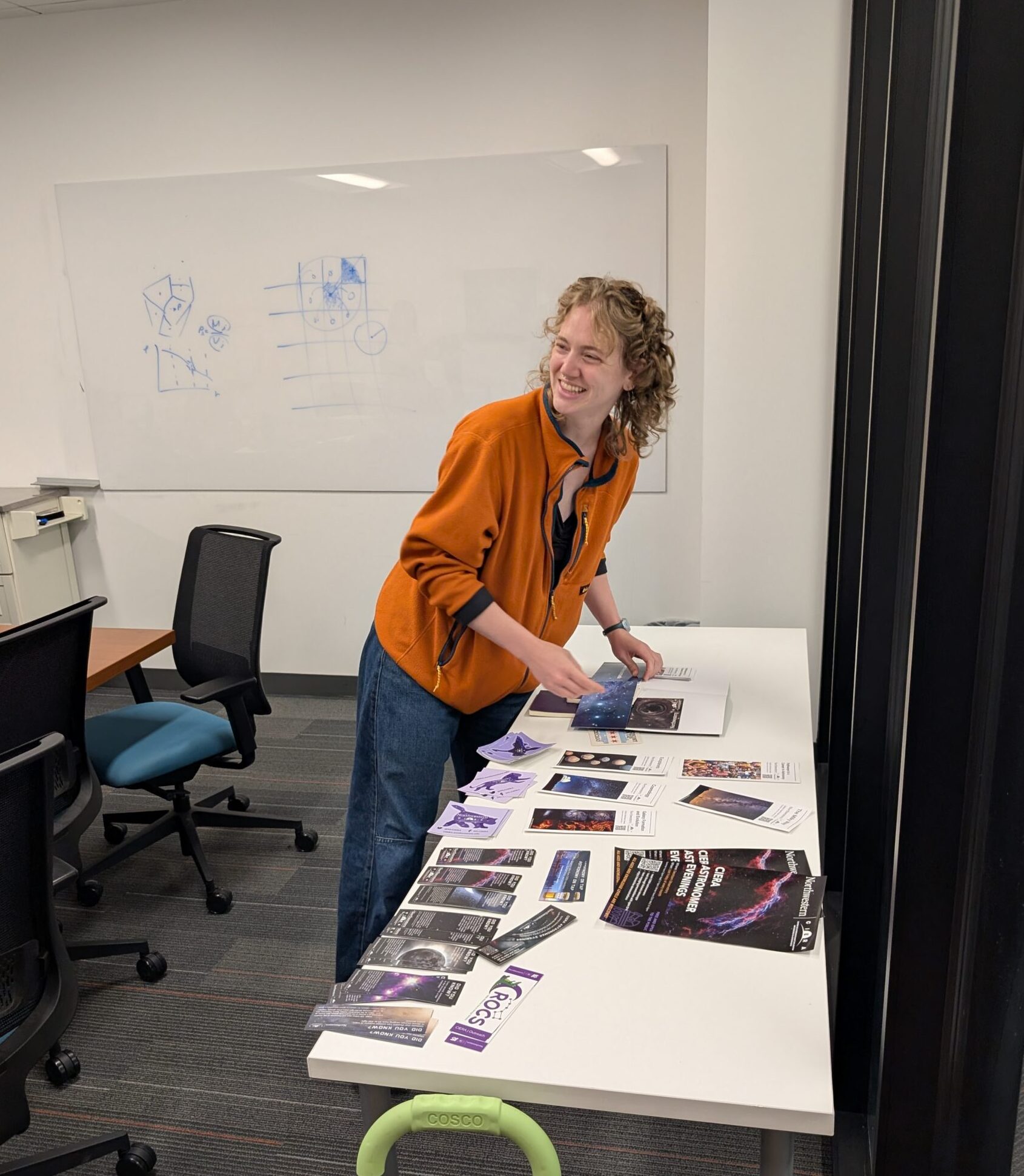
Emily Wentorf at CIERA
The curriculum-development workshops were designed with Northwestern professional development partner institution, the Baxter Center for Science Education, a local initiative to promote student STEM engagement and leadership opportunities for teachers.
Prosser Career Academy high school science teacher Emily Wentorf and Dewey School of Excellence middle school science teacher Michael Dixon worked with mentor and Northwestern Assistant Professor Alison Strom. Using spectroscopy, or the study of wavelengths to understand how matter interacts with light, the teachers researched how stellar mass influences the chemical composition of galaxies over time.
Dixon said participating in the RET program transformed his understanding of what astronomy research looks like.
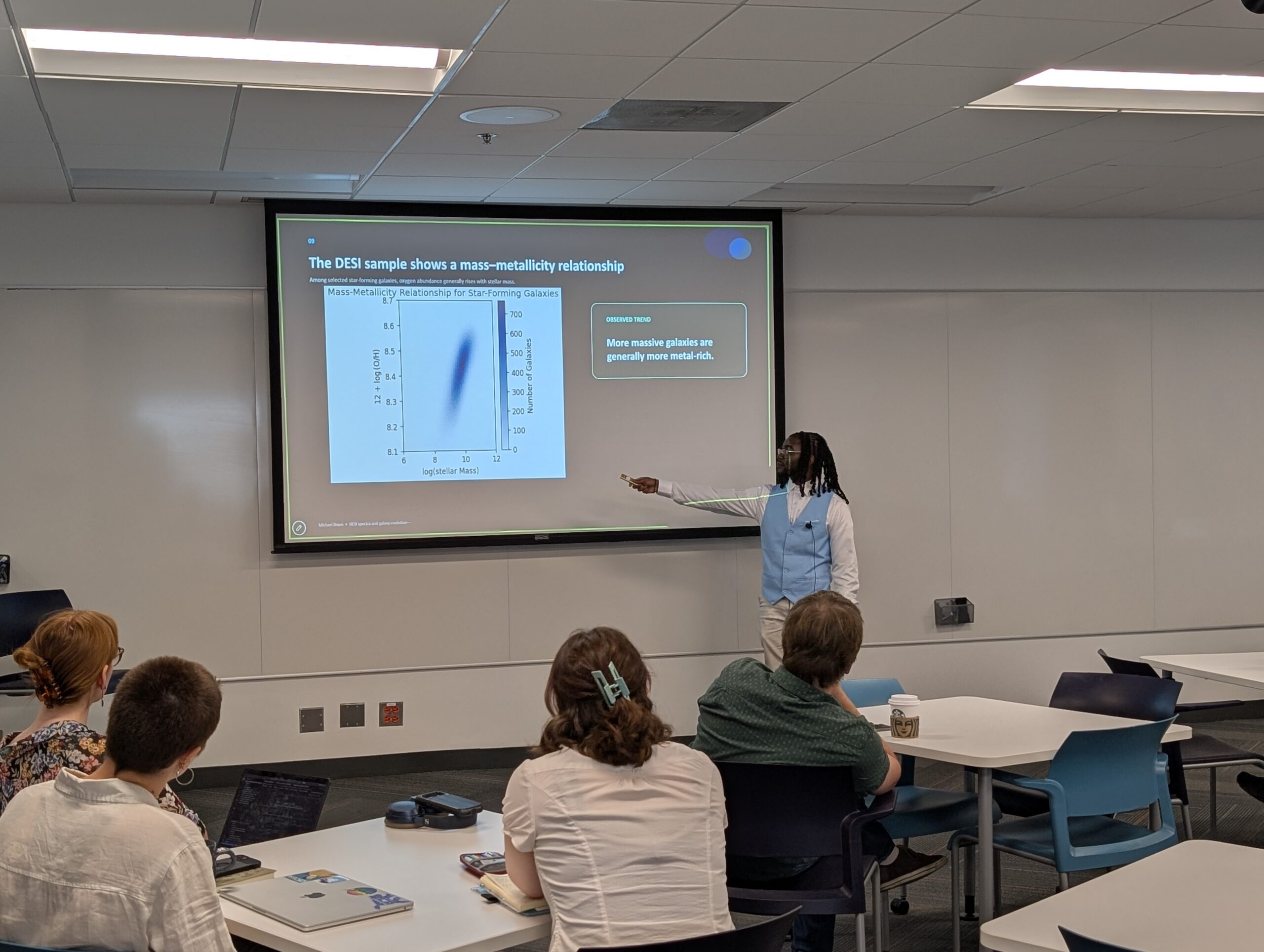
Michael Dixon presenting his research and curriculum plans at CIERA
“I hear astronomical facts all the time, took a beginner astronomy course, but I never understood how we actually know what we know about our universe until this research program,” Dixon said.
The teachers developed their curricula to align with the Next Generation Science Standards, performance expectations for kindergarten through twelfth-grade students to develop skills in communication, collaboration, inquiry, problem solving, and flexibility.
After completing their RET, the four educators are now part of a program alumni network, which Schottelkotte said CIERA hopes to continue to engage with through classroom visits, workshops, and sharing resources for years to come, to keep improving the quality of science education in Chicagoland schools.