


Applications will open March 2027!
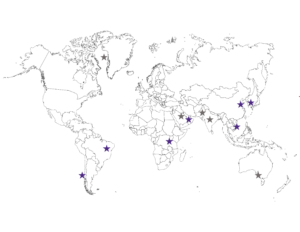
REACH Online is a new 6-week, online course hosted through CIERA. This is an asynchronous, interactive counterpart to the in-person REACH program, intended to reach students throughout the world. In our pilot summer of 2026, we had 24 applicants from 11 countries across the world, and our inaugural “graduating” class of REACH Online students represented 9 countries across 6 time zones!
Participants build a strong foundation in astronomy-related scientific computing. Using our CIERA-built online python tutorial — REACHpy — as a guide, students develop coding skills through applications to fundamental astronomical problems. This course contains both live and asynchronous online elements, making it more accessible to motivated students interested in STEM coding regardless of location.
The course includes recorded videos of instruction, online community-building, collaboration, discussion boards, Astronomy 101 lectures by experts, and mini-projects from REACHpy. The program also offers live Zoom office hours for questions, problem-solving, and personalized feedback from our CIERA-based facilitators and teaching assistants.
E-mail ciera-hsprogram@northwestern.edu with any questions!
100% of students reported that they would recommend the program to a friend!
“I really enjoyed the time to complete tasks with your guidance. Though sometimes I made some simple mistakes, you are always patient to help me check code. You are an amazing mentor!”
“I like to study and learn independently, so a format that includes both synchronous and asynchronous modules works perfectly, since I can learn on my own with the materials given to us, and then, via instruction, online classes and the good environment that comes along with working with other peers, I can get to apply all of that effort that I put on both formats. “
Program Learning Outcomes
- Identify and define fundamental building blocks of the python language such as functions, variables, lists, arrays, conditional statements, loops, libraries, and modules.
- Utilize the fundamental building blocks of the language to implement basic mathematical and statistical procedures for simple computations.
- Create simple data visualizations that support data analysis.
- Understand and identify ways that scientific computing enables present-day scientific (astrophysical) inquiry.
- Develop familiarity with and confidence in scientific computing along with an awareness of what a profession in astrophysics may look like.